

Let me be blunt: Voice search isn't killing your local business: but your competitors who are optimizing for it might be.
Here's what's really happening. While you're still thinking about traditional SEO, your customers are asking Siri "Where's the best pizza near me?" and Google Assistant "Find a plumber close by." And guess whose business they're calling? Not yours.
The numbers don't lie. "Near me" searches combined with voice queries have exploded by 150% since 2020. Nearly half of all voice searches have local intent, meaning someone is actively looking for a business like yours right now. The question isn't whether voice search will impact your business: it's whether you'll be the business that benefits from it or gets left behind.
The Voice Search Reality Check
Voice search has fundamentally changed how customers discover local services. Google Assistant processes over 1 billion voice searches monthly, while Siri handles 25 billion requests across Apple devices. More importantly, 88% of consumers who perform a local search on their smartphone visit or call a store within a day.
Think about that for a second. These aren't casual browsers: they're high-intent customers ready to buy, book, or schedule immediately.
The businesses that get this are already winning. A roof repair company in Ohio gained 37% more calls in just 60 days after optimizing for voice search. A bakery in Portland became the top voice result for "custom cakes near me" and now books three weeks out consistently.

Strategy #1: Master Your Google Business Profile
Your Google Business Profile is your voice search lifeline. Businesses with complete profiles are 70% more likely to attract location-based voice inquiries. But "complete" doesn't mean just filling in the basics.
Here's what most businesses miss:
- Business hours (including holiday hours)
- Multiple high-quality photos from different angles
- Detailed service descriptions
- Payment methods accepted
- Appointment booking links
- Regular posts and updates
Voice assistants prioritize comprehensive, up-to-date information. When someone asks "What time does the tire shop close?" and your hours aren't listed, you've lost that customer to the competitor who did their homework.
Strategy #2: Lock Down NAP Consistency Everywhere
NAP stands for Name, Address, Phone number: and inconsistency is voice search poison. Voice assistants cross-reference multiple sources before making recommendations. Even minor differences like "Street" versus "St." or different phone number formats can confuse the algorithm and tank your visibility.
Your NAP needs to be identical across:
- Google My Business
- Apple Maps
- Bing Places
- Yelp
- Industry-specific directories
- Your website
- Social media profiles
This isn't optional. Make it your non-negotiable foundation.
Strategy #3: Think Like Your Customers Actually Talk
Here's where most businesses screw up: they optimize for keywords people type, not phrases people say.
When someone types, they might search "emergency plumber." When they use voice search, they say "I need a plumber right now" or "Where's the nearest plumber that's open late?"
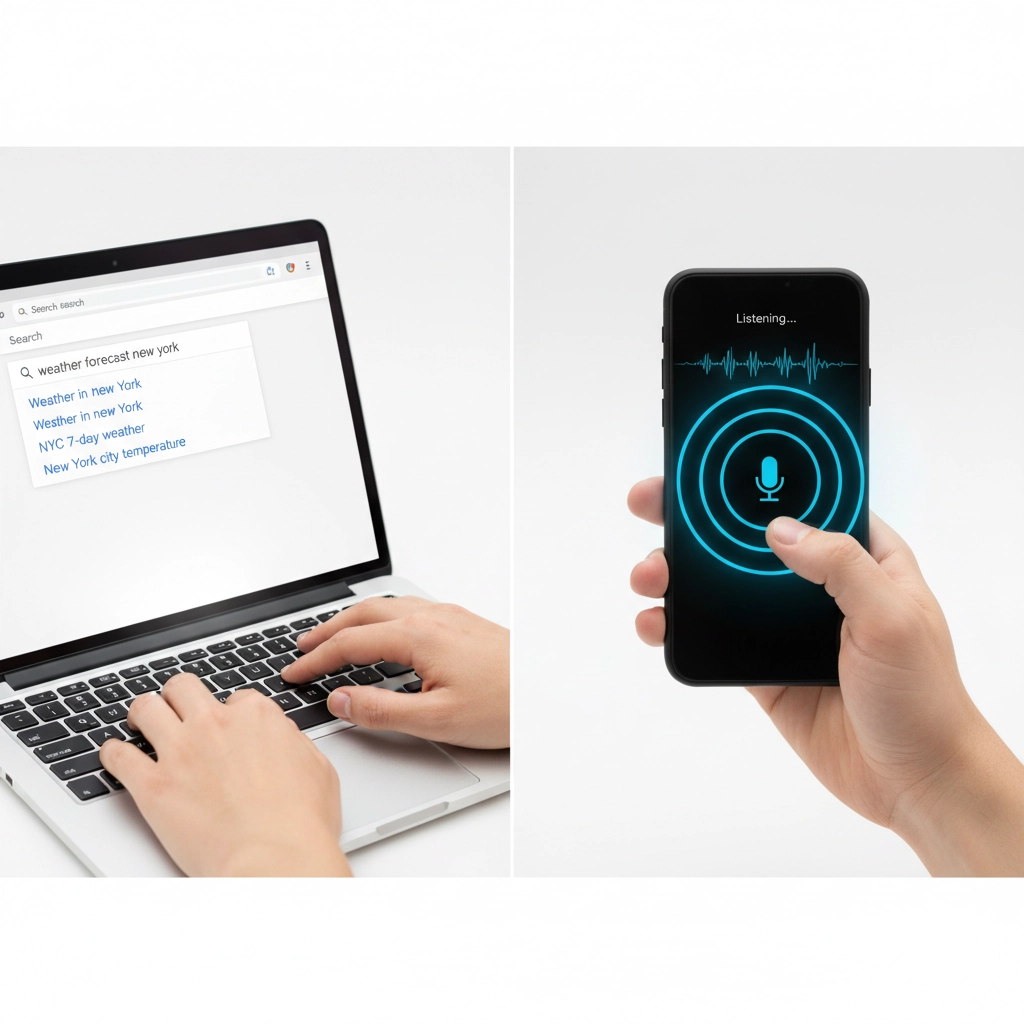
Start listening to how your customers actually phrase their needs:
- "Pizza place walking distance from downtown"
- "Dentist that takes my insurance near the mall"
- "Auto shop close to the highway"
- "Hair salon in my neighborhood"
Use tools like Google's autocomplete feature and AnswerThePublic to discover these natural language variations. Build your content strategy around how people actually speak, not how they type.
Strategy #4: Create Hyperlocal Content That Matters
Voice search rewards specificity. Generic content gets ignored. Community-specific content gets recommended.
Instead of "How to Choose a Contractor," create "Best Home Renovation Tips for Victorian Houses in Downtown Portland" or "Winter Plumbing Problems Common in Denver Neighborhoods."
This hyperlocal approach works because voice assistants prioritize relevant, specific answers. A landscaper who started creating content about yard care specific to their city's climate and soil conditions doubled their voice search traffic in four months.
Strategy #5: Structure Content for Voice Assistants
Voice assistants love clear, conversational answers they can read aloud. This means restructuring your content around FAQ formats and direct questions.
Use FAQ schema markup to help search engines understand your content structure. Format your answers conversationally:
Instead of: "Our establishment provides comprehensive automotive maintenance services."
Use: "We fix brakes, change oil, and handle all car maintenance. We're open Monday through Saturday and offer same-day service for most repairs."

The goal is content that sounds natural when read aloud by a voice assistant. Short, clear sentences work better than long, complex paragraphs.
Strategy #6: Turn Reviews into a Voice Search Advantage
Reviews don't just build credibility: they fuel voice search visibility. Voice assistants consider review signals when determining which businesses to recommend.
But here's the key: actively respond to reviews. This engagement signals to search engines that you're a responsive, legitimate business worth recommending.
Set up review monitoring and respond within 24 hours. Thank positive reviewers and address concerns professionally. This active community engagement amplifies your voice search presence significantly.
Strategy #7: Optimize for Mobile-First Voice Experiences
Voice searches happen on smartphones, smart speakers, and in cars. Your website must deliver information quickly and clearly across all these contexts.
Essential mobile optimizations for voice search:
- Page load speed under 3 seconds
- Clear navigation and readable fonts
- Contact information prominently displayed
- Click-to-call buttons
- Location and directions easily accessible
- Service pages that answer specific questions
Remember, voice search users often want immediate action: calling your business, getting directions, or booking an appointment. Make these actions as simple as possible.
The Bottom Line: Act Now or Get Left Behind
Voice search optimization isn't some future trend you can address later. It's happening right now, and your competitors are already capturing customers you're missing.
The businesses embracing these strategies are experiencing increased calls, foot traffic, and bookings today. Those ignoring voice search are becoming invisible to ready-to-buy customers who are asking their devices for exactly what you offer.
The leveling effect is particularly powerful for small local businesses. Voice search prioritizes relevance and accuracy over business size, meaning a well-optimized small business often outranks larger competitors in voice results.
Your size isn't your disadvantage: your optimization is what matters.

The choice is simple: optimize for voice search now and capture high-intent local customers, or keep doing what you've always done and watch those customers call your competitors instead.
The businesses winning in 2025 understand that voice search isn't killing local businesses: it's transforming how the smartest ones grow. Which side of that transformation will you be on?



0 Comments